Department overview
The Department of Chemical Science and Engineering at the Graduate School of Engineering, Kyoto University, was newly established in 2026 through the consolidation and reorganization of six chemistry-related departments (Material Chemistry, Energy and Hydrocarbon Chemistry, Molecular Engineering, Polymer Chemistry, Synthetic Chemistry and Biological Chemistry, and Chemical Engineering). The aim of this reorganization is to respond to the growing and accelerating demands placed on the field of chemistry by society and to cultivate researchers and engineers who can address urgent issues.
Chemistry, as an academic discipline, is often called "Central Science," and its greatest characteristic is its interdisciplinary nature. Historically, it had deep connections with physics through thermodynamics, statistical mechanics, and quantum mechanics. In recent years, its importance has also increased in relation to biology through biochemistry and molecular biology, as well as to computer science and data science. In this context, the importance of research and development based on traditional, compartmentalized classifications such as "physical chemistry," "organic chemistry," and "inorganic chemistry" is gradually declining. At the same time, new research fields that span multiple disciplines or do not fit into any existing academic field are emerging one after another. The designation of this department as "Chemical Science and Engineering" signifies its overarching objective to encompass the entirety of chemistry, unencumbered by the constraints of a particular academic domain, as well as the contribution to the advancement of science and engineering through the foundational principles of chemistry.
The overarching objective of this department is to methodically furnish students with sophisticated, specialized competencies and a comprehensive, interdisciplinary understanding. The department seeks to establish a research and educational institution that is characterized by its adaptability and responsiveness. Education and research organization consists of two main elements:
1. Educational Organization : "Tracks"
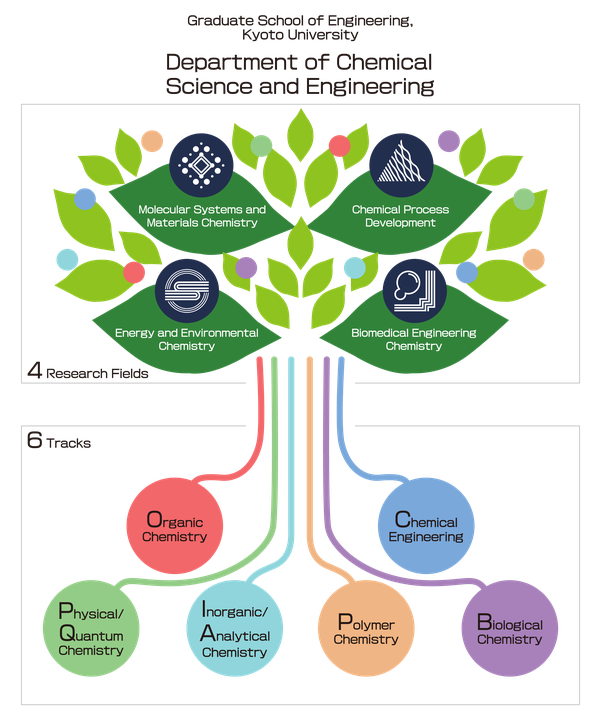
With the aim of acquiring systematic academic knowledge, the curriculum consists of six subject groups: "Physics and Quantum Chemistry," "Organic Chemistry," "Inorganic and Analytical Chemistry," "Polymer Chemistry," "Biochemistry," and "Chemical Engineering." Lectures and practical exercises are conducted by faculty members from each track. Students are able to consolidate their specialized knowledge in accordance with their primary track.
2. Research Organization: "Research Fields" and "Research Modules"
This organization consists of four Research Fields: "Molecular Systems and Materials Chemistry," "Biomedical Engineering Chemistry," "Chemical Process Development," and "Energy and Environmental Chemistry" and promotes cutting-edge research. On-the-Research Training (ORT) is conducted within these research fields by research modules (RMs). These Research Fields and RMs are regularly reviewed in response to changes in global research trends and societal demands.
A distinctive feature of this system is that the "Tracks" (deepening of specialized knowledge) students take and their affiliated "Research Fields" are not necessarily one-to-one correspondences. This allows students to experience collaborative work with researchers from different fields from the early stages of graduate school. Furthermore, the "Global Course in Chemical Science and Engineering" is established to address globalization, providing lectures in English.