Educational Structure (6 Tracks) / Educational Policy
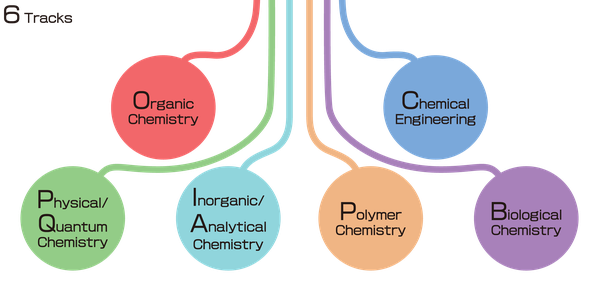
The educational structure of the Department of Chemical Science and Engineering is composed of six "Tracks" with the aim of deepening students' specialized knowledge through the systematic acquisition of academic disciplines. This system is based on the recognition that the importance of "acquiring academic disciplines" such as "physical chemistry," "organic chemistry," and "inorganic chemistry" has not diminished even in today's world of increasing specialization of research fields. Students select one or two tracks and receive systematic specialized education centered on their main track.
Educational Policy and Course Requirements for the Master's Program (Total 30 Credits)
The Master's Program provides a systematic education through lectures and seminars led by faculty members from each Track, as well as on-the-job training (ORT) in "Research Modules (RM)" within "Research Fields (RF)." Students aim to deepen their specialized knowledge and cultivate interdisciplinary knowledge by taking four types of courses offered by the program.
Characteristics of the Educational Policy
The essence of this educational policy lies in its ability to balance the deepening of specialized knowledge with the cultivation of interdisciplinary knowledge.
Students take "Tracks" to deepen their specialized knowledge, but the "Research Fields" to which they belong for research activities do not necessarily correspond one-to-one with the "Tracks". This allows students to gain experience collaborating with faculty and students with different areas of expertise from their own track, even in their early years of graduate school, thus fostering interdisciplinary knowledge.
Furthermore, in the master's program, an interim presentation of the master's thesis research is held in the "area" to provide an opportunity to gain a broad overview of the significance of the research by receiving advice from researchers in different fields. On the other hand, the master's thesis defense is conducted in the "track" to which the core subjects were taken, ensuring that students receive precise questions from faculty and students in the same field of expertise, thus reliably connecting the acquisition of specialized knowledge.
Doctoral Program Requirements
The doctoral program focuses on research supervision and activities in "Research Modules (RM)" within "Research Fields (RF)." To graduate, students must complete at least 10 credits, though they may not specify particular courses.