Introduction of Research Organizations (4 Research Fields)
To respond to expanding and rapidly changing social demands while adhering to the policy of not establishing fixed subordinate organizations that would subdivide research fields, the Department of Chemical Science and Engineering's research organization has a flexible, agile structure centered on a two-tiered system of "Research Fields (RFs)" and "Research modules (RMs)".
Research Fields (RFs):
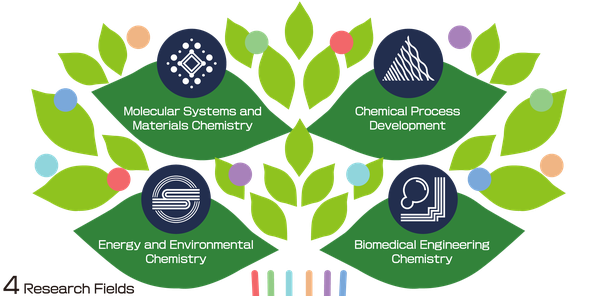
The research organization is based on the above four "Research Fields (RFs)" that cover all fields of chemistry.
Agility: The organization of these RFs is not fixed. It is reviewed and revised periodically (about every six years) at the faculty meeting in response to societal needs, either to restructure or continue.
Management: Each RF has a head who, along with two research planning professors who coordinate between areas, plays a role in monitoring societal issues and organizing Research Modules (RMs) strategically.
Relationship with Education: Students belong to these RFs with their supervisors and receive research guidance through on-the-job training (ORT) in the RMs within their areas. In the master's program, students give an interim presentation of their thesis research within their RFs and RMs. This provides an opportunity to receive advice from faculty and students with diverse expertise and fosters the ability to view one's own research from a broad perspective.
Research Modules (RMs):
RMs are established within a "Research Field (RF)" and form the core of research activities. These groups consist of 5 to 20 researchers, including professors, associate professors, lecturers, and assistant professors, who can belong to them independently, transcending the boundaries of individual research laboratories. Members can hold positions in multiple RMs simultaneously. Additionally, RMs spanning multiple domains or collaborating with other departments, such as the Institute for Chemical Research, the Graduate School of Informatics, other universities, or companies, are also envisioned.




Molecular Systems and Materials Chemistry
- Functional Materials Design(Fujita Lab.)
- Inorganic Structural Chemistry
- Industrial Solid-State Chemistry(Tanaka Lab.)
- Polymer Physics and Function(Urayama Lab.)
- Biomaterials Chemistry(Numata Lab.)
- Fundamental Glass Science(Masuno Lab.)
- Solid State Chemistry(Kageyama Lab.)
- Synthetic Organotransformation(Nakamura Lab.)
- Structural Organic Chemistry(Murata Lab.)
- Organic Functional Materials Chemistry(Fukazawa Lab.)
- Theoretical Chemistry(Sato Lab.)
- Photo-organic Chemistry(Imahori Lab.)
- Condensed Matter Physical Chemistry(Seki Lab.)
- Quantum Material Science(Mizuochi Lab.)
- Molecular Rheology
- Organic Materials Science(Kaji Lab.)
- Quantum Molecular Science
- Porous Physical Chemistry
- Advanced Functional Polymers
- Functional Polymer Synthesis(Sugiyasu Lab.)
- Synthetic Polymer Chemistry(Ouchi Lab.)
- Polymerization Chemistry(Tanaka Lab.)
- Polymer Structure and Function(Ohkita Lab.)
- Polymer Molecular Science(Nakamura Lab.)
- Fundamental Physical Chemistry(Koga Lab.)
- Polymer Materials
- Molecular Design of Polymer(Takenaka Lab.)
- Polymer Controlled Synthesis
- Biomaterials
- Organic System Design
- Functional Chemistry(Ogoshi Lab.)
- Physical Organic Chemistry(Matsuda Lab.)
- Organometallic Chemistry(Ishida Lab.)
- Molecular Assembly Chemistry(Furukawa Lab.)
- Soft Matter Engineering(Yamamoto Lab.)
- Materilas Process Engineering
- Environmental Process Engineering
- Dynamic Interfacial Chemistry(McNamee Lab.)
Biomedical Engineering Chemistry
- Analytical Chemistry of Materials
- Hydrocarbon Chemistry Fundamentals
- Advanced Biomedical Chemistry(Kondo Lab.)
- Bio-macromolecular Science(Sasaki Lab.)
- Developmental Systems
- Bioorganic Chemistry
- Molecular Biology(Takahashi Lab.)
- Biorecognition Chemistry(Miki Lab.)
- Biochemical Engineering(Atomi Lab.)
- Transport Phenomena(Maeda Lab.)
Chemical Process Development
- Surface Control Engineering
- Chemical Reaction Engineering(Kawase Lab.)
- Separation Engineering(Sano Lab.)
- Process Control and Process Systems Engineering(Sotowa Lab.)
- Green Process Engineering
Energy and Environmental Chemistry
- Organic Reaction Chemistry(Ohmiya Lab.)
- Organic Molecular Chemistry(Nakao Lab.)
- Applied Electrochemistry(Abe Lab.)
- Functional Materials Chemistry(Sakka Lab.)
- Catalyst Materials(Abe Lab.)
- Catalytic Organic Chemistry(Fujiwara Lab.)
- Catalyst Design Engineering
- Organotransition Metal Chemistry(Ohki Lab.)
- Isotope Chemistry(Sato Lab.)
- Catalysis Chemistry(Teramura Lab.)
- Energy Process Engineering(Tanabe Lab.)