【Molecular Systems and Materials Chemistry】Overcoming a Long-standing Dilemma in Organic Photovoltaics: Successful Development of Lossless Power Generation Technology for a Low-Carbon Society
Professor Hideo Ohkita of the Graduate School of Engineering, Kyoto University, in collaboration with a joint research team led by Professor Itaru Osaka (Graduate School of Advanced Science and Engineering, Hiroshima University), has successfully addressed a critical trade-off in organic photovoltaics (OPV). The team—which included Assistant Professor Tsubasa Mikie and Shota Suruga (Hiroshima University), Team Director Keisuke Tajima, and Senior Researcher Kyohei Nakano (RIKEN), Professor Hiroyuki Ishii (University of Tsukuba), and Dr. Shin Inamoto (Toray Research Center, Inc.)—demonstrated the simultaneous achievement of “low voltage loss” and “high-efficiency charge generation.” This breakthrough is a vital step toward the realization of high-efficiency, next-generation solar cells.
Organic photovoltaics (OPV) are lightweight, flexible, and can be manufactured through low-cost coating processes, making them a promising next-generation solar technology. However, they have historically suffered from higher voltage loss compared to inorganic silicon or perovskite solar cells.
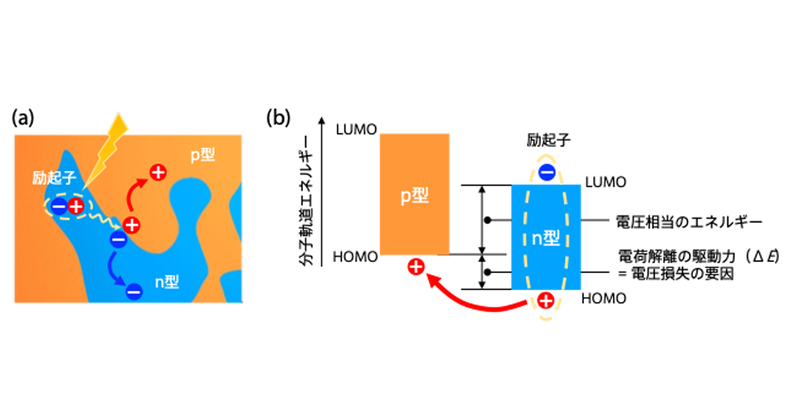
In the power generation mechanism of OPVs, excitons dissociate into holes and electrons at the heterojunction interface between p-type and n-type organic semiconductors. This process typically involves an energy loss (ΔE), which contributes to voltage loss. A fundamental dilemma exists where efforts to suppress this voltage loss to increase voltage often lead to a reduction in current. Overcoming this “voltage-current trade-off” has been a major challenge for the field.
The research team utilized a novel polymer semiconductor, PTNT1-F (developed by Hiroshima University), as the photoactive material. This allowed the development of an OPV that significantly reduces voltage loss while maintaining or exceeding the high current density of conventional OPVs.
The breakthrough was achieved through an interdisciplinary approach: Kyoto University, Hiroshima University, and RIKEN performed spectroscopic measurements to analyze charge dynamics; Toray Research Center, Inc. conducted morphology analysis via advanced electron microscopy; and the University of Tsukuba provided theoretical insights through quantum chemical calculations. The results demonstrated that the “backbone rigidity” of PTNT1-F promotes “hole delocalization,” which is the key factor enabling efficient charge generation even with minimal energy loss.
These findings establish a new design principle for polymer semiconductor molecular structures. By further optimizing these materials, the realization of ultra-high-efficiency OPVs that balance high voltage and high current is expected. This achievement will contribute significantly to the development of environmentally harmonious energy technologies for a low-carbon society.
This research was published online in Communications Materials (Springer Nature), an international academic journal in the field of materials science, at 7:00 PM (JST) on Monday, March 23, 2026.
Paper Information
| Title | Backbone rigidity promoting hole delocalization and enabling efficient charge generation with minimal voltage loss in nonfullerene organic photovoltaics |
| Authors | Shota Suruga, Tsubasa Mikie*, Yuki Sato, Kazuki Kohzuki, Jihun Jeon, Hyung Do Kim, Shin Inamoto, Hiroyuki Ishii, Kyohei Nakano, Keisuke Tajima*, Hideo Ohkita*, Itaru Osaka* |
| Journal | Communications Materials (Springer Nature) |
| DOI | 10.1038/s43246-026-01115-y |
| KURENAI | http://hdl.handle.net/2433/300112 |