【Molecular Systems and Materials Chemistry】Redox Asymmetry Enables the First Iron-Based Oxyhydride
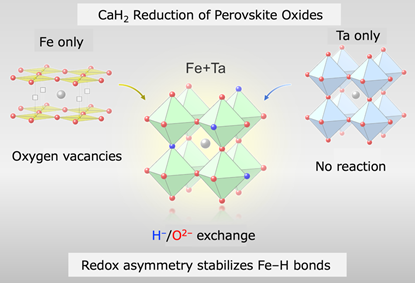
For decades, iron-based oxyhydrides remained conspicuously absent from the growing family of oxyhydride materials. Although iron is abundant, inexpensive, and widely used in catalysis and magnetism, attempts to introduce hydride ions into iron oxides typically resulted in oxygen-deficient phases rather than the formation of Fe–H bonds. As a result, stabilizing iron–hydrogen bonds in crystalline oxyhydrides had remained an unsolved challenge.
A research team led by Yuki Sasahara, formerly a postdoctoral researcher at Kyoto University and now an assistant professor at Hokkaido University, together with Professor Hiroshi Kageyama of Kyoto University, has now synthesized the first iron-based perovskite oxyhydride, BaFe₀.₅Ta₀.₅O₂.₇H₀.₃. By combining readily reducible iron with redox-inactive tantalum, the researchers established a new design principle based on “redox asymmetry”, which directs reduction toward hydride incorporation while preserving the crystal framework.
The team found that tantalum remains in the +5 oxidation state throughout the reaction, stabilizing the structure and suppressing the formation of oxygen vacancies. Instead, hydride ions are incorporated into the lattice, resulting in stable Fe–H bonds and a mixed-valence Fe²⁺/Fe³⁺ state. Remarkably, the material remains stable in both air and water despite the generally high reactivity of Fe–H species.
Beyond the synthesis of a new material, the study demonstrates that differences in reducibility between constituent elements can be exploited to control solid-state reaction pathways. This concept of redox asymmetry provides a new framework for designing oxyhydrides and other functional materials, potentially enabling previously inaccessible compounds and expanding the scope of solid-state chemistry.
The findings were published online in the Journal of the American Chemical Society on June 2, 2026.
Paper Information
| Title | Redox Asymmetry Enables Fe–H Bonds in Perovskite Oxyhydrides |
| Authors | Yuki Sasahara, Susumu Fujii, Daichi Kato, Rina Terada, Tomoko Onoue, Kei Saito, Kei Morisato, Suraj Mahato, Ryotaro Tanabe, Masatomo Yashima, Ko Mibu, and Hiroshi Kageyama* |
| Journal | Journal of the American Chemical Society |
| DOI | 10.1021/jacs.6c06588 |
| KURENAI |