【Molecular Systems and Materials Chemistry】Realization of Practical-Level Circularly Polarized Luminescence in Thin Films Using Liquid Crystalline Emissive Dyes — Expected Applications in Optoelectronics —
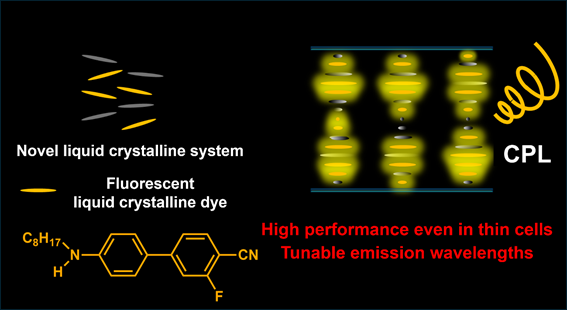
Assistant Professor Masayuki Gon and Professor Kazuo Tanaka in the Department of Polymer Chemistry, Kyoto University, in collaboration with a research team including graduate student Yuto Iida and Associate Professor Gen-ichi Konishi at Science Tokyo, and Associate Professor Hiroyuki Yoshida at Kwansei Gakuin University, have successfully achieved practical-level circularly polarized luminescence (CPL) using cholesteric liquid crystals composed of highly concentrated liquid crystalline emissive dyes. This systems can be fabricated with a liquid crystal layer thickness approximately one-tenth that of conventional ones.
Cholesteric liquid crystals are liquid crystal phases in which molecules are arranged in a helical structure and exhibit an optical property known as “selective reflection,” whereby only circularly polarized light within a specific wavelength range is preferentially reflected. The beautiful metallic luster of certain beetles, such as scarab beetles, also originates from this selective reflection. In recent years, CPL generated by doping small amounts of emissive dyes into cholesteric liquid crystals has been actively studied, with potential applications in next-generation sensing and optical communication technologies. However, although CPL systems exhibit high emission efficiency, they suffer from slow response speeds required for switching emission on and off and for controlling the emission direction in response to external stimuli. Therefore, it has been recognized that minimizing the thickness of the liquid crystal layer to enhance its mobility is essential.
In this study, the research team developed “liquid crystalline organic π-conjugated emissive dyes” and proposed that their incorporating into cholesteric liquid crystals would significantly enhance both emission and selective reflection, thereby enabling thinner liquid crystal layers. Furthermore, a model was constructed to identify key factors governing CPL enhancement based on the emission mechanism. By utilizing a liquid crystalline fluorescent dye recently reported by the team, which exhibits high miscibility with conventional liquid crystals, cholesteric liquid crystals containing a high concentration (~50%) of emissive dye were successfully fabricated. As a result, high-performance CPL was achieved in a thin film of only 2 μm, approximately one-tenth the thickness of conventional systems. In addition, emission of the three primary colors (RGB) was successfully realized by employing Förster resonance energy transfer (FRET).
These results contribute to a fundamental understanding of the mechanism of CPL generation and are expected to facilitate the development of optical materials and devices for next-generation information security technologies, such as invisible inks based on circular polarization and circularly polarized LEDs.
This work was published online on February 27 (local time) in Aggregate (impact factor 13.7), an international journal in the fields of aggregation science and materials, published by Wiley.
Paper Information
| Title | Development of a Cholesteric Liquid Crystal Comprising a Mesogenic Fluorophore for Circularly Polarized Luminescence With a High Dissymmetry Factor |
| Authors | Yuuto Iida, Masayuki Gon,* Hiroyuki Yoshida, Kazuo Tanaka, Gen-ichi Konishi* |
| Journal | Aggregate, 2026, 7, e70304. |
| DOI | 10.1002/agt2.70304 |
| KURENAI | http://hdl.handle.net/2433/300108 |