【Biomedical Engineering Chemistry】Construction of Fluorescent Zinc Sensors in the Brain of Living Mice: Recording and Quantitative Mapping of Brain Zinc Ion Dynamics
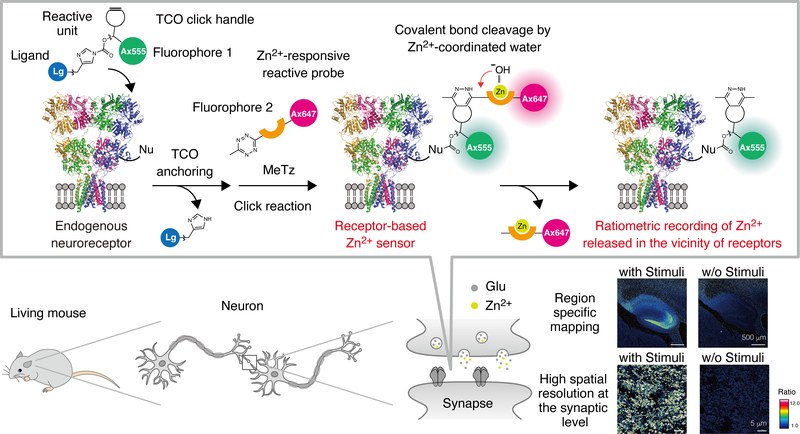
A Kyoto University team led by Prof. Itaru Hamachi, Asst. Prof. Hao Zhu, Assoc. Prof. Seiji Sakamoto, Asst. Prof. Keisuke Nakamura, and Assoc. Prof. Hiroshi Nonaka of the Biomedical Engineering Chemistry area has developed a novel method to record and quantitatively map the dynamics of zinc ions released into synaptic clefts in response to neural stimuli. By combining "in-brain ligand-directed chemistry" and "click chemistry," the team successfully constructed zinc-responsive fluorescent sensors directly on target neurotransmitter receptor proteins within the brains of living mice, achieving precise quantitative analysis for the first time globally. Zinc plays a crucial role in synaptic plasticity, memory, and learning. This methodology is expected to significantly deepen our understanding of zinc-regulated brain functions and contribute to elucidating the underlying mechanisms of neurological disorders.
Bibliographic Information
| Title | Imaging and recording of synaptic zinc in the brain by covalent-chemistry based semisynthetic biosensors |
| Authors | Hao Zhu, Seiji Sakamoto, Keisuke Nakamura, Chengli Qiu, Kohei Nakajima, Hiroshi Nonaka, Itaru Hamachi* |
| Journal | Proceedings of the National Academy of Sciences of the United States of America (PNAS) |
| DOI | 10.1073/pnas.2606947123 |
| KURENAI | http://hdl.handle.net/2433/303943 |